
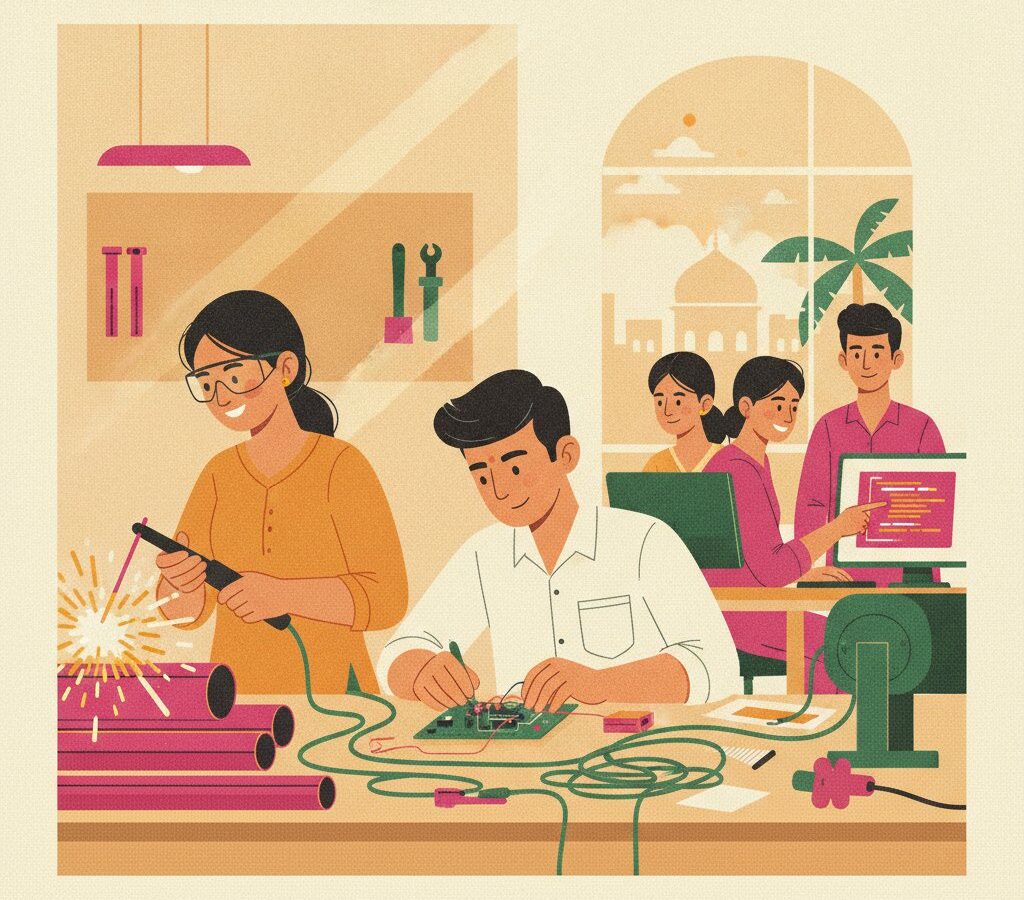
India is often described as sitting on a demographic dividend — a vast and young working-age population that could, if properly skilled, drive economic growth for decades. The key word is if. The gap between the education millions of young Indians receive and the skills employers actually need is one of the country’s most discussed and least easily solved challenges. The Skill India mission, launched in 2015 and built on a foundation of existing Industrial Training Institutes (ITIs) and polytechnics, represents the most ambitious attempt yet to close that gap systematically.
The Infrastructure That Already Exists
Before Skill India, the country already had one of the world’s largest vocational training networks. ITIs have existed since the 1950s, offering trade-based training from electrical work and plumbing to machining, welding, and IT. Their strength is reach: they operate in small towns where universities do not exist. Their challenge has been relevance — curricula that sometimes lagged behind industry, and a perception problem in which vocational training was seen as a fallback rather than a valued pathway. Skill India set out to change both the scale and the perception, through the National Skill Development Corporation and a network of dedicated skilling centres aiming to train millions annually across construction, healthcare, retail, electronics, and logistics.
Where the Mission Has Shown Promise
The introduction of a National Skills Qualifications Framework gave India a standardised system for recognising and comparing skill certifications across sectors — a prerequisite for employers to trust them. The apprenticeship push has been particularly significant: by amending apprenticeship laws and encouraging industries to take on apprentices, the government acknowledged that classroom training alone cannot substitute for learning in a real workplace.
- Recognition of Prior Learning: pathways for informal workers — carpenters, masons, tailors — to have existing skills formally certified.
- Sector-specific focus: industry-led Sector Skill Councils to keep training aligned with employer needs.
- Women’s participation: programmes specifically targeting women, including in non-traditional trades.
The Gap Between Training and Good Work
The honest assessment requires confronting a gap that training programmes everywhere struggle with: completing a course is not the same as finding quality employment. Placement rates have been inconsistent and difficult to verify independently, and some programmes have been faulted for prioritising certification numbers over genuine skill acquisition. There is also the structural question no skilling programme can resolve alone: the economy must actually generate enough good-quality jobs. Skilling is a supply-side intervention; without parallel growth in labour demand, even well-trained young people find themselves overqualified for available work and underqualified for work that pays well. The social stigma around vocational work, while diminishing, has not disappeared.
The Work That Lies Ahead
The Skill India mission is best understood not as a completed project but as a framework in progress. The infrastructure is real, the intent serious, and the reforms meaningful. What turns potential into outcome is sustained attention to quality over quantity, honest measurement of employment results, and the parallel work of creating an economy in which skilled hands find work worthy of their preparation. India’s demographic dividend is not automatic. It is earned — one genuinely skilled, meaningfully employed young person at a time.