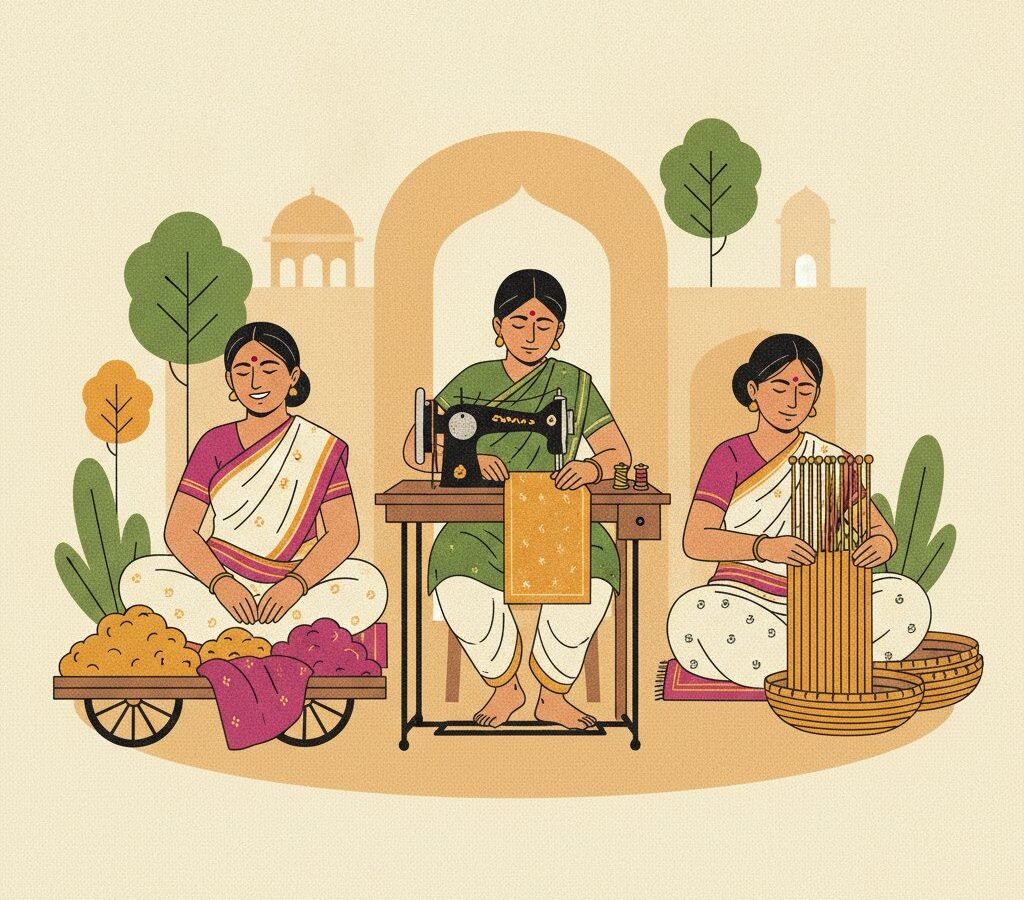
Most of India’s working women have always existed outside the frame through which economic policy sees workers. They are not in factories with contracts or offices with provident-fund accounts. They are vegetable vendors, bidi rollers, home-based garment stitchers, construction labourers, domestic workers, and waste-pickers — participants in a vast informal economy that generates a substantial share of national output while offering almost none of the protections of formal employment. For decades, organising them was considered nearly impossible.
The Self-Employed Women’s Association, known as SEWA and founded in Ahmedabad in 1972 by Ela Bhatt, began with the argument that this was wrong — not just ethically, but analytically. These women were workers. The fact that they lacked a single employer or a fixed workplace did not disqualify them from the logic of organising.
What SEWA Built
SEWA registered as a trade union, and from the start it operated on a different premise than most labour organisations. Its members were self-employed women whose work conditions were shaped by middlemen, by the credit market, by seasonal demand, and by domestic burdens. SEWA recognised that organising them meant addressing all of those things at once, not just wages. Over time it built a federation of institutions: a cooperative bank — the SEWA Bank — so members could access credit without surrendering to moneylenders; producer cooperatives so women in particular trades could negotiate together; and social-security and health programmes, because women whose income vanished when they fell ill had no protection unless SEWA helped build one.
Membership, Reach, and the Model’s Spread
By the time SEWA had been active for a generation, its membership had grown to hundreds of thousands of women across Gujarat and beyond. It became one of the best-known examples of informal-sector organising internationally, consistently cited by the International Labour Organization and researchers as a demonstration that self-employed women could organise effectively and that the results — in income, financial access, and bargaining power — were measurable. Its influence on policy was real, feeding into debates that produced legislation on unorganised workers’ welfare and establishing the case that informal workers deserved deliberate policy attention.
The Honest Limits
SEWA’s story is not a story of solved problems. The informal economy its members inhabit remains large, poorly paid, and structurally precarious. SEWA demonstrated that organising was possible; it did not demonstrate that organising was sufficient. The women who joined gained credit, mutual support, collective negotiation, and political visibility. What they did not gain, in most cases, was the stable, well-paid, protected work that a well-functioning formal economy can provide. The model has been replicated by women’s organisations across South Asia and beyond — each adaptation a recognition that the core insight was both right and transferable. What Ela Bhatt and the women who built SEWA offered was a refusal to accept that the invisible were unorganisable. Fifty years later, that refusal has shaped how millions of working women understand their place in the economy — not as isolated individuals at the mercy of markets they cannot influence, but as members of something with a voice.