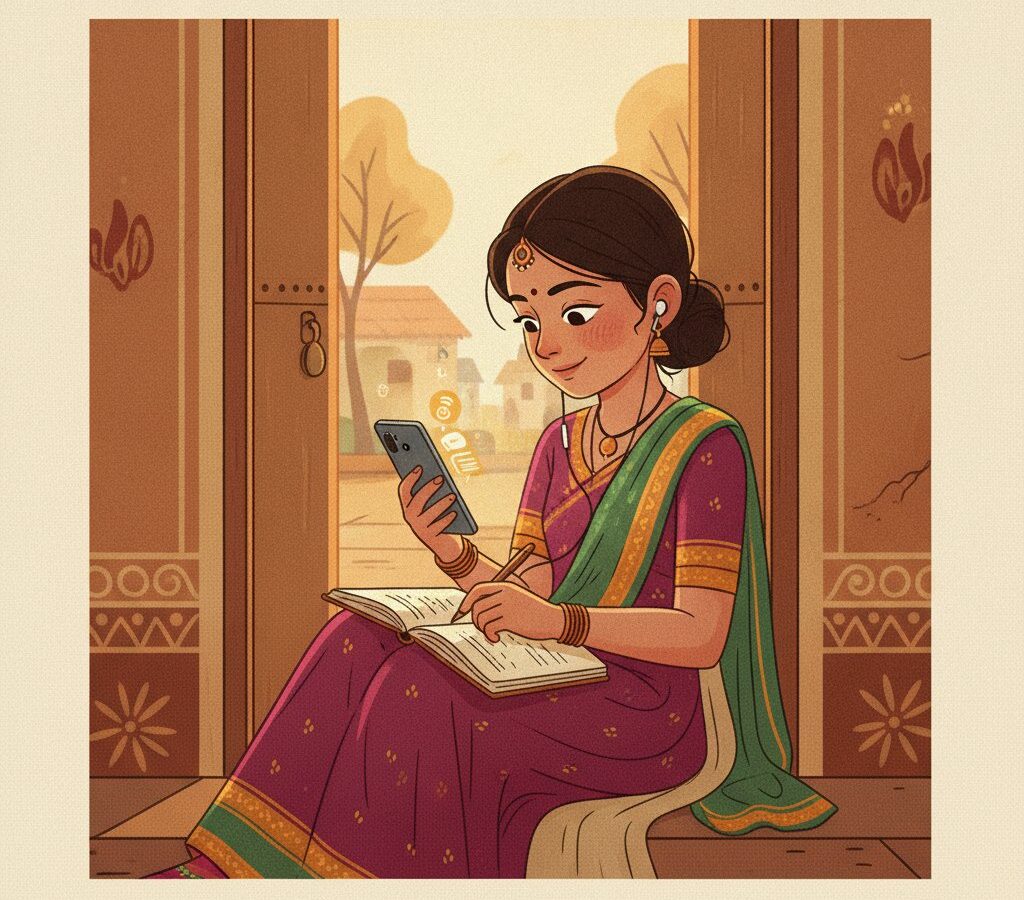
On a quiet afternoon in a small town in Jharkhand, a girl sits on her front step, earphones plugged in, watching a mathematics lesson on her mother’s smartphone. The teacher on screen is explaining fractions in Hindi. She pauses the video, scribbles in a notebook, then replays the same forty seconds three times until she understands. Two years ago, that patient repetition was a luxury only children with private tutors could afford.
This is what the digital learning revolution looks like up close: not a flashy classroom, not a pitch deck, but a borrowed phone and a free government app quietly doing something remarkable.
The Infrastructure That Changed the Equation
India’s two flagship public platforms — DIKSHA and SWAYAM — are among the largest free educational repositories in the world. DIKSHA offers textbook-linked content aligned to state curricula, available in more than twenty Indian languages. A child studying under the Maharashtra board can find lessons in Marathi; one in Tamil Nadu can follow the same concept in Tamil. The vernacular anchoring is the design principle, because learning in one’s mother tongue is among the most robustly supported ideas in education research.
SWAYAM carries university-level courses taught by faculty from the IITs, IIMs, and central universities. For a first-generation college student in a district where no engineering college exists, access to a course taught by an IIT professor represents a genuine democratisation of aspiration. Both platforms are free, and both work, at least in part, on low-bandwidth connections.
What Cheap Data and Affordable Phones Made Possible
The arrival of low-cost data in India did not just create a market for streaming. It quietly rewired how tens of millions of people could access knowledge. Content that once required a computer lab — or a school building at all — can now travel to a student wherever she is. Videos can be downloaded overnight and watched offline; audio explanations work even when video buffers. For children whose schools are understaffed, or whose day is interrupted by farm labour, the asynchronous nature of digital learning is not a workaround — it is the point.
The Honest Reckoning: Who Is Still Left Out
None of this is a solved problem.
- Device access remains uneven. In many low-income households, one smartphone is shared across the family, and a child’s study time competes with a parent’s work needs.
- Electricity is not guaranteed. Unreliable power makes charging a device its own challenge.
- Connectivity still has edges. Signal quality in hilly terrain, tribal belts, and remote districts remains genuinely poor.
- The teacher cannot be replaced. Children who struggle with foundational literacy need a skilled, responsive adult — something no platform yet does reliably at scale.
Education researchers who tracked pandemic-era remote schooling have been sobering: access to a device and access to learning are not the same thing.
Where the Real Progress Lives
The most promising models are hybrid. States that combined DIKSHA content with trained classroom teachers — using the platform to enrich lessons rather than substitute for them — reported steadier gains. Community learning centres, where a shared device and a trained volunteer bring structured sessions to children who have neither device nor reliable electricity at home, bridge the gap in a way individual access cannot. India’s digital education revolution is not yet a revolution for everyone. But where the infrastructure holds, the will is present, and the content speaks a student’s own language, something genuinely hopeful is taking root — and it deserves both celebration and the honest work of being widened.