
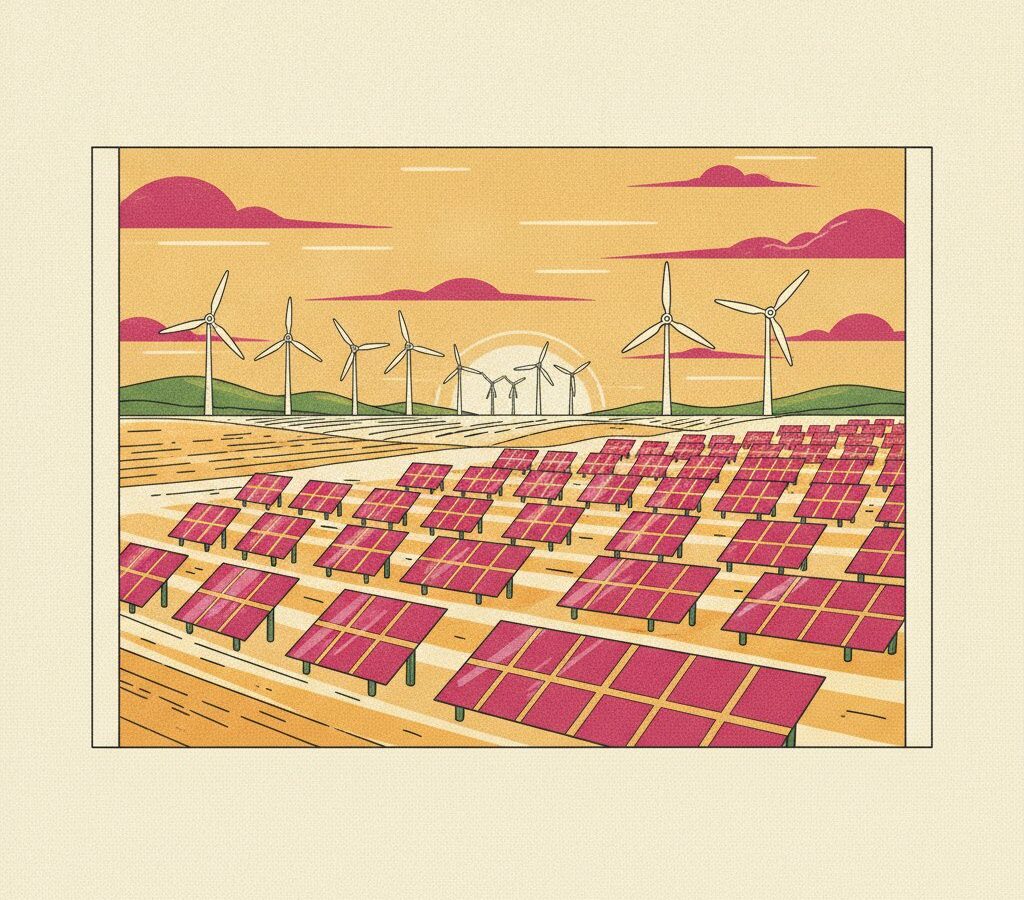
Stand at the edge of the Thar Desert in Rajasthan on a clear morning and you will see something that would have seemed fantastical two decades ago: kilometre after kilometre of blue-black solar panels drinking in the sun, feeding power into a grid that stretches from the Himalayas to the tip of Kerala. India’s clean-energy transition is not a future aspiration. It is happening, visibly, at enormous scale.
The Mission That Changed the Frame
The pivot has roots in deliberate policy. When the National Solar Mission was launched as part of the National Action Plan on Climate Change, it set an ambition considered audacious at the time: make India a global leader in solar energy. What followed was a sustained push — state governments competed to attract developers, and the cost of solar equipment fell so dramatically that auctions began producing some of the cheapest electricity tariffs in the world. India now ranks among the world’s largest solar markets by installed capacity, earned through sheer volume of deployment.
The Parks and the Panels
India’s solar story has two chapters running at once. The first is the age of utility-scale solar parks — vast installations in places like Bhadla in Rajasthan, Pavagada in Karnataka, and Rewa in Madhya Pradesh — which aggregate land, transmission, and approvals so developers can focus on building. The second is quieter but arguably more transformative: rooftop solar. Across Indian towns, panels are appearing on homes, factories, hospitals, and schools. A family in Pune or Jaipur installing rooftop solar is not making a lifestyle statement — they are making a rational financial calculation that increasingly favours renewables.
Wind’s Long-Standing Contribution
Solar dominates headlines, but wind has been part of India’s clean-power story for much longer. The coastal and elevated terrain of Tamil Nadu, Gujarat, Maharashtra, and Rajasthan has hosted turbines since the 1990s, and India has developed genuine domestic manufacturing capability. Offshore wind represents the next frontier along India’s long coastline.
Leading the World’s Solar Alliance
India’s ambitions have not stopped at its borders. The International Solar Alliance, headquartered near New Delhi, was co-founded by India as a coalition of sunshine-rich countries — many of them developing nations — to accelerate solar deployment globally. It represents a distinctive kind of soft power: India helping shape the global energy transition, particularly for the Global South.
The Honest Reckoning
- Coal dependence remains deep. India is still among the world’s largest consumers of coal for electricity. Renewables have grown, but so has demand — meaning coal has been supplemented more than displaced.
- Grid integration is genuinely hard. Matching variable solar and wind to demand requires sophisticated grid management and better transmission.
- Storage is the missing link. Deploying battery storage at the scale India needs remains a major investment and logistical challenge.
- Land and community concerns. Large parks require large tracts of land, creating tensions that must be navigated with care.
None of these is fatal to the project, but they explain why the transition, while genuinely impressive, is also genuinely incomplete.
What the Trajectory Suggests
The direction of travel is clear, and for once the economics are aligned with the environmental imperative. Solar and wind are now cheaper than new coal in most Indian contexts. The question is no longer whether India will build a large renewable sector — it already has — but how quickly and fairly it can integrate that capacity into a grid that still carries the legacy of a fossil-fuel past.