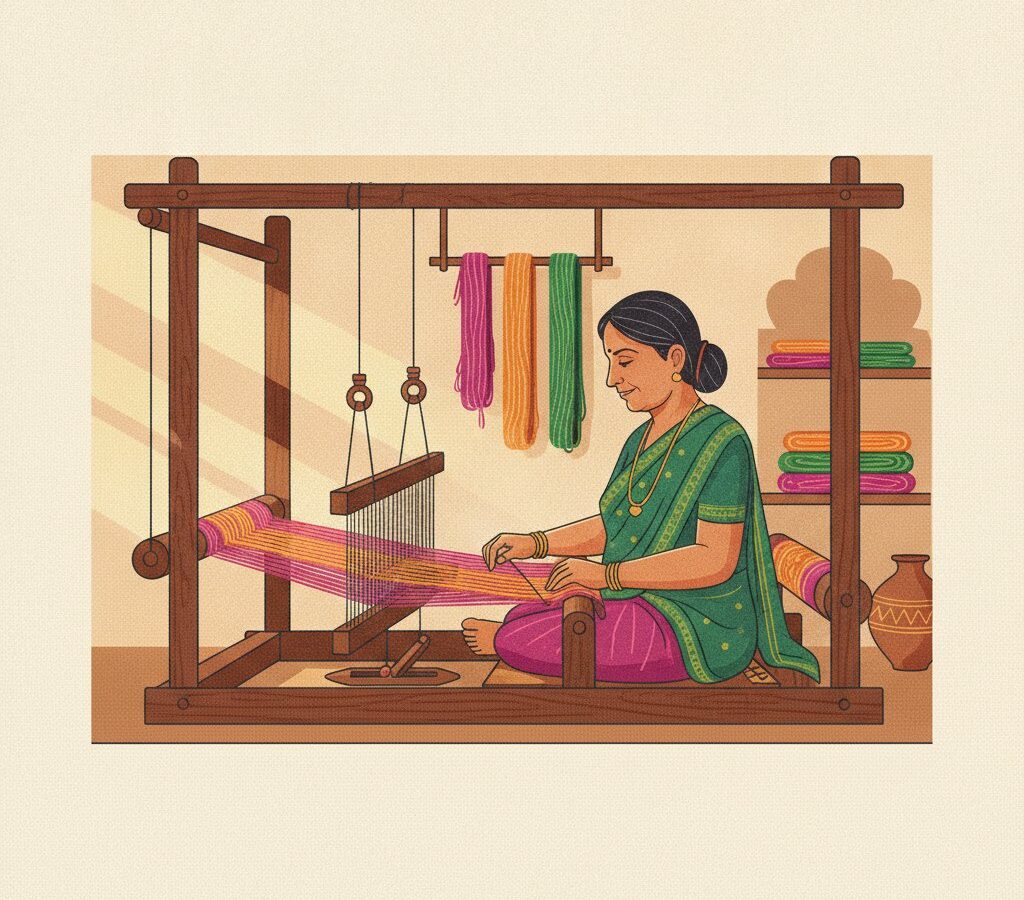
In a narrow lane in Varanasi, a weaver sits before a pit loom, his feet working the treadles in a rhythm learned from his father, and his father’s father before that. The motif taking shape — a delicate gold buti against deep crimson silk — is older than the city’s most famous temples. That this weaver today also receives orders through a smartphone, with buyers from Bengaluru to Berlin, is the quietly remarkable story of India’s handloom and handicraft revival.
A Living Heritage Under Pressure
India carries one of the largest handloom sectors in the world. Millions of weavers and artisans — concentrated in states like Uttar Pradesh, Tamil Nadu, Telangana, West Bengal, Andhra Pradesh, Assam, and Manipur — sustain traditions ranging from the gossamer muslins of Bengal to the bold tribal weaves of the Northeast. Yet for much of the late twentieth century that knowledge was under siege. Power looms could replicate the surface appearance of handwoven fabric at a fraction of the cost. Middlemen captured most of the value, leaving the weaver — often working in debt to the very trader who sold his cloth — with a fraction of the final price.
The Turning: GI Tags and the Value of Authenticity
Geographical Indication protection is one of the most consequential threads in the revival. When a craft receives a GI tag — as Banarasi silk, Kanjeevaram silk, Pochampally ikat, Pashmina, and Chanderi now have — it gains a legally defensible identity. The tag tells a buyer that this fabric was made in this place, by artisans using these methods, drawing a bright line between the genuine article and a machine-made imitation. Enforcement remains uneven, but the name itself becomes a quality signal that the artisan community, rather than a distant corporation, owns collectively.
Design Collaboration and the Fashion Dialogue
Another current runs through design studios and conscious retail. A growing number of Indian designers have built their identity around handloom fabrics, and the more thoughtful collaborations involve the artisan in the design conversation — adapting traditional motifs for contemporary silhouettes and experimenting with natural dyes. Questions of fair attribution and equitable pricing are live and contested, but the best partnerships have proven that handloom fabric, positioned honestly, commands a price that can sustain a dignified livelihood.
E-Commerce, Natural Dyes, and the Conscious Consumer
Digital platforms have transformed the reach available to weavers’ cooperatives and small craft enterprises. Clusters that once depended on a single trader can now list directly online or run their own social storefronts, in meaningful cases bypassing several layers of intermediaries. Alongside this, the global turn toward sustainable textiles has given natural dyes — plant-based indigo, turmeric, pomegranate rind — a market credibility they lacked when chemical dyes seemed simply modern. Khadi occupies a special place: carrying the moral weight of the independence movement, it has been reimagined by younger designers and worn by a generation that finds its simplicity genuinely stylish.
What Remains Unfinished
Honesty requires naming what has not changed. In too many clusters, the weaver remains the most economically vulnerable actor in a long chain. Middlemen who control raw material and market access have not disappeared, and the wage for a day at the loom has often not kept pace with the price finished fabric commands in premium retail. Women, who do much of the pre-loom work, often receive even less recognition and pay. The handloom sector’s path is not to compete on volume or price, but to make its difference legible and valued: the slight variation of hand, the integrity of natural fibre, the human story behind cloth. That story, told well and paid for fairly, is precisely what a growing cohort of consumers is beginning to seek.