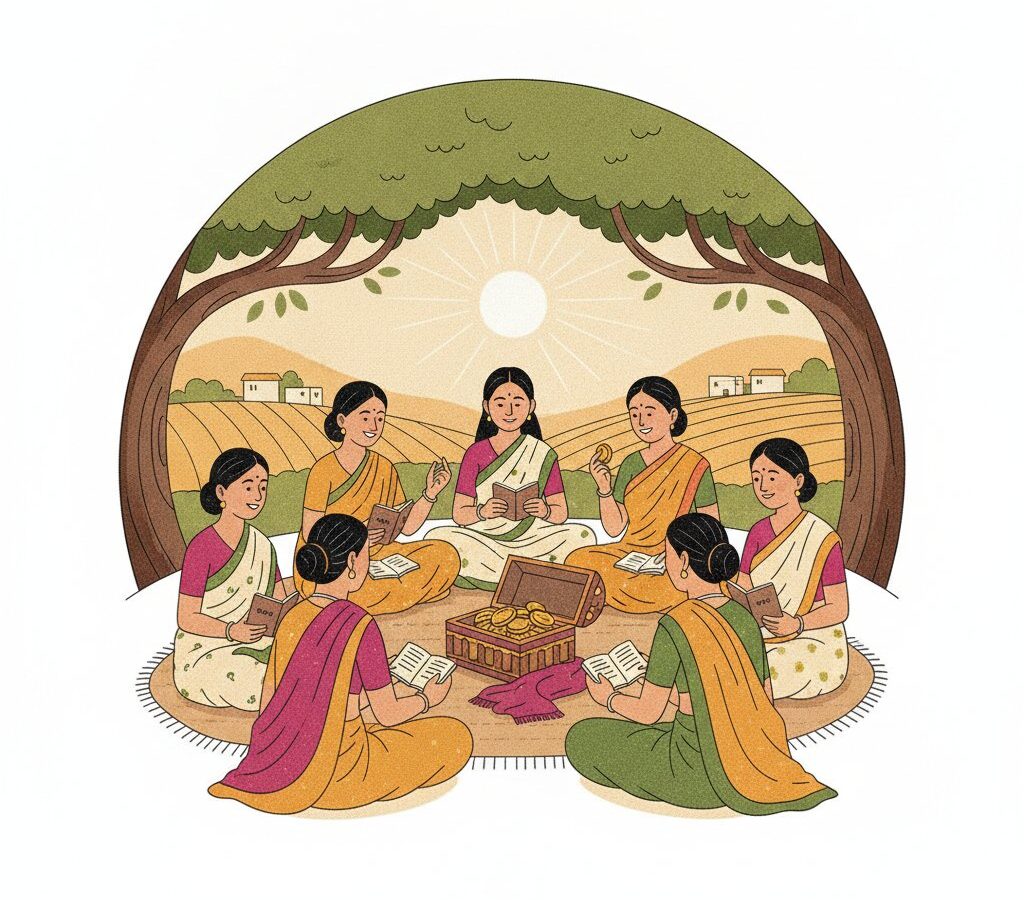
In a village panchayat room in rural Jharkhand, or under a peepal tree in Andhra Pradesh, or in a borrowed school hall in Odisha, a familiar ritual plays out each week. Eight to twenty women sit together, each contributing a small sum — sometimes just a few rupees — into a common pool. They record the amount in a passbook, discuss who needs a loan, and vote on it. Then they go home. The meeting rarely lasts more than an hour.
This modest gathering is the atomic unit of one of the largest self-organised financial movements in the world. India’s self-help group network now spans hundreds of thousands of villages and connects tens of millions of women to savings, credit, and collective economic agency. It is a story that seldom makes front pages, yet development economists and public-health researchers increasingly regard it as one of independent India’s most significant social experiments.
What a Self-Help Group Actually Is
A self-help group, or SHG, is a small, voluntary association of women from similar socioeconomic backgrounds who meet regularly to save money together and lend it back to members in need. The principles are deliberately simple:
- Regular saving: Every member contributes at each meeting. The act of saving, however small, builds the group’s internal corpus.
- Internal lending: Members can borrow from the pooled fund at a modest, collectively-decided rate — often far lower than a moneylender would charge.
- Collective accountability: The group as a whole stands behind each loan, which creates peer accountability without punitive coercion.
- Transparent records: Accounts are kept openly, with passbooks updated at every meeting.
Once a group has operated consistently and demonstrated discipline, it becomes eligible to link with a formal bank — a process known as bank linkage — through which it can access larger credit than its internal corpus would allow.
The NRLM and the Scale of Ambition
Self-help groups existed in India well before the government entered the picture — pioneered by organisations like SEWA and several state-level movements. But the National Rural Livelihoods Mission, under the Ministry of Rural Development, transformed a promising grassroots model into a nationwide infrastructure project. Known in many states as Aajeevika, it set out to mobilise rural poor women at a scale earlier efforts could not reach, providing handholding support, revolving funds, and a sustained state commitment that outlasted electoral cycles.
Why the Model Works — and Where It Struggles
The SHG model succeeds where many top-down poverty programmes have stumbled because it builds on existing social capital. Women in the same village already know each other’s circumstances. The group formalises trust that was already present, rather than manufacturing it from outside. Research across states has documented real improvements: higher rates of bank account ownership, reduced dependence on informal moneylenders, and measurable increases in women’s participation in local governance.
Yet honesty requires acknowledging what does not always work. Outcomes vary enormously by state, district, and the individual energy of a group’s members. Some groups remain at the level of small savings with little economic transformation. Bank linkage can be slow and bureaucratically frustrating. Women in the most marginalised communities often need far more support than a savings group alone can provide. The SHG is a powerful tool, not a complete solution.
A Model Worth Understanding
What distinguishes the self-help group movement is that it is genuinely owned by its participants. The weekly meeting is not something done to rural women; it is something they run. That quality of ownership — rare in large-scale poverty programmes — is probably why the model has proved durable across decades, governments, and shifting policy fashions. In a country where formal finance long ignored the rural poor, that is, in fact, rather large.