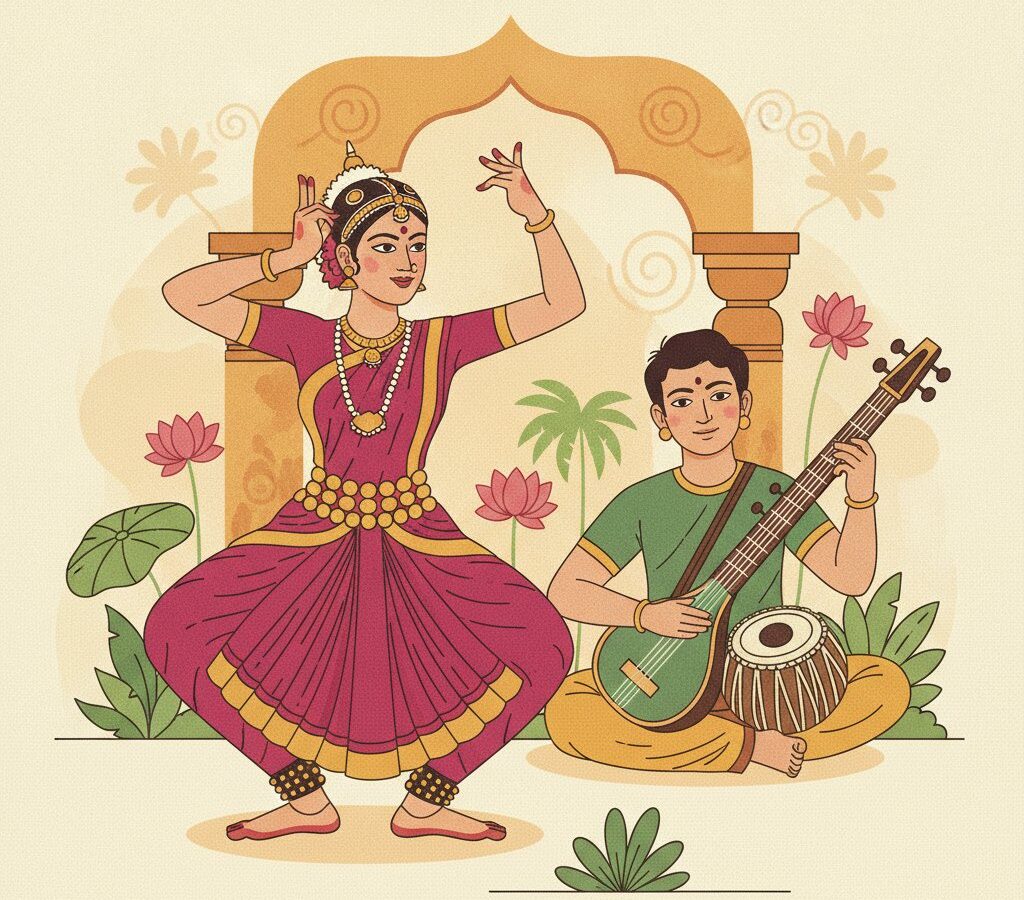
There is a moment near the end of a Bharatanatyam recital — the stillness between the concluding tillana and the first wave of applause — where time seems to fold. The dancer may be in her twenties, studying at a conservatory in Chennai or Bengaluru, but the vocabulary of her body reaches back centuries. This is the particular miracle of India’s classical traditions: they are not museum pieces. They are living, continuously renegotiated inheritances.
Many Streams, One River
India recognises a set of classical dance forms under the frameworks of the Sangeet Natak Akademi and broader scholarly consensus: Bharatanatyam, Kathak, Odissi, Kuchipudi, Manipuri, Mohiniyattam, Kathakali, and Sattriya. Each carries its own aesthetic grammar — the angular geometry of Bharatanatyam differs profoundly from the lyrical softness of Mohiniyattam, while Kathak’s Mughal-court history gives its footwork a distinct character. Yet all are unified by the theoretical bedrock of the Natya Shastra, the ancient treatise that codifies gesture, expression, and rhythm into a common language. Music is similarly bifurcated but complementary: Hindustani classical music flourished in the courts of the north, absorbing Persian influences alongside its roots, while Carnatic music of the south is more compositionally dense, structured around elaborate krithis that are simultaneously devotional poetry and technical architecture.
The Guru-Shishya Bond
What makes these traditions live rather than merely persist is the guru-shishya parampara — the lineage of teacher to student that has transmitted precise, embodied knowledge across generations without relying solely on notation. A student entering a gharana is absorbing a way of listening and practising from the inside out. This knowledge lives in the body, in the correction of a single finger position, in the timing of a breath before a pause. Cultural institutions support the model through fellowships and recognition, though the challenges are real: fewer young people can commit the decade-long immersion the tradition demands, and regional forms command smaller audiences than the most prominent ones.
A New Stage: Digital, Global, Alive
The generation now inheriting these traditions has taken them online without cheapening them. Concert recordings of legendary artists have accumulated large audiences on platforms that did not exist when they performed. Young dancers document their practice on social media, demystifying a particular expression or rhythmic pattern and building audiences who may never have entered a concert hall. Festivals like the Chennai Music Season have grown in prestige and broadened their reach through live streaming, while dance festivals at Khajuraho and Konark place performers against the very temple architecture that inspired these forms. A young Kathak dancer incorporating contemporary choreography draws debate; a Carnatic vocalist experimenting with new harmonics is both celebrated and scrutinised. This friction is not a crisis — it is the tradition working as it always has, through the negotiation between what is received and what is re-made. India’s classical arts are not frozen in amber. They are, as they have always been, in motion.